Showing posts with label misc. Dali collectible. Show all posts

Tuesday, August 21, 2012

Franklin Mint "Sombra Sobre la Playa" (Shadow on the Beach, 1977) by Salvador Dali.

Franklin Mint "Sombra Sobre la Playa"
(Shadow on the Beach, 1977)

by Salvador Dali

It seems that the few extant authentic plaque-style Dali art collectibles are all pretty rare.  Such is the case with this great piece.

Published by the Franklin Mint in 1977, it features an original work by Salvador Dali, etched in solid sterling silver, and issued in a single limited edition.  It comes packaged in an attractive black and silver frame, double-matted with beige over black.  The mat has a blind stamp in the lower right corner.

The brushed silver surface catches the light and reflects it back, changing appearance depending on the angle.  A pretty neat effect that makes it look like its glowing in any kind of light.

This work is sealed in the frame, so I have not inspected the entire plaque.  Therefore, its weight and overall dimensions are unknown.  The visible area of the plaque is about 23.7 cm x 34.1 cm.

It is not known how many of these were published, but it is extremely rare.  It typically sells for fewer than $300, and  I was lucky enough get mine for fewer than half that.  My advise is to patiently wait, and you should be able to get one of these for your collection at a bargain price.


Thursday, July 12, 2012

Lincoln Mint "Easter Christ" (1972) Variants.

Presented here are a few variants to this common collectible which have recently joined my collection.


The first is this beautiful Easter Christ in 24K gold on sterling silver (vermeil).  It comes in the same box as the sterling version except that the cover logo is in gold, and the interior is done in white satin. 


This version tends to be far more scarce than the sterling version, but auction results suggest that its value is about the same as the sterling version.


This one is serial number 2153 of a limited edition.

The next variant comes in the form of a sterling version box that is missing the cover logo.  In all other respects, the box is identical to the regular sterling version box.
This plate is still sealed in its original packaging, so I am not sure what serial number it has.  On information and belief, the serial number is likely either 5326 or 5393.

The final variant is a bit of an enigma, and might be in a class of its own.

It comes packaged in a box that, on the outside, looks like a regular sterling version.  However, the logo on the inside of the lid is very different.  It appears to be a sticker stuck on top of the satin.

The plate itself is not stamped with a serial number on the underside.  It only has the number "27" stamped into it.

The metal of this plate feels flimsy.  It can be bent easily with the hands.  In fact, it came to me a bit warped around the rim.

It seems poorly made, and one artifact of its flawed production is the ghost imprint under the nail on one arm of the cross.  This imprint does not exist on authentic versions of this plate.

The plate weighs 321.5 grams within its plastic shrink wrap, which is close enough to the mass of the known sterling version (~ 315-323 g) to make this a decent counterfeit.

I hypothesize that this version is either a sales sample or a proof.  On the other hand, it could just be a counterfeit made of a base metal.

I have not seen another of these, so more information is needed about this item.


Finally, here is something you don't see every day: an original magazine advertisement for the Easter Christ plate.  The purchase price is listed as $150.  At that time, silver cost about $2 per ounce, so the plate had fewer than $20 worth of silver in it!!!


Sunday, February 19, 2012

Dali's Teatro Museo Figueras Inauguration 1974 Coin/Medal/Medallion.

Dali's Teatro Museo Figueras
Inauguration 1974
Coin/Medal/Medallion

This coin was likely minted to commemorate the September 1974 inauguration of Dali's Teatro Museo in Figueras Spain. 

One side of the coin is dated "28 IX 74" which corresponds to the museum's opening.

It is a shiny silver color and has been represented to be sterling silver, however no silver hallmarks are visible on this tiny coin. 

It is about 17 mm in diameter (just a bit smaller than a US dime), and has about a 2.2 gram mass.

Nothing more is known about this coin, and it seems quite rare. If it is truly composed of sterling silver, then it is likely worth about $15.


Saturday, October 22, 2011

Dali's Tribes of Israel Bronze Medallion: "Joseph."

Dali's Tribes of Israel
Bronze Medallion:

"Joseph."

The second I saw this medallion at auction, I knew it was destined to join my collection.

Not because of the Israel/Jewish reference (I have no connection to either), but because both the name and the date of its production are of special significance to me.

The medal is 5cm in diameter, and consists of about 80g of bronze.  A stamp on the rim identifies the maker as Medallic Art Co., N.Y. 

This medal is number 315.  I do not know how many sets of these medallions were produced.

Usually, one sees the Tribes of Israel medallions sold as complete sets in a number of competing editions most commonly in bronze and silver. 

In my experience, a single medal from a set like this is rarely sold by itself.  In fact, I can only remember seeing two sets of these round medallions in silver at auction over the past year, but none in bronze.

I have no other sales from which to approximate a value, but I think that I got mine for a great bargain: fewer than $30.

Monday, September 5, 2011

1988 U.S. Olympic Dali Medallions.

1988 U.S. Olympic Dali Medallions
by Deak International

This set of five olympic medallions is packaged in a dark blue flocked case.  Each medal is embedded in a clear plastic holder so you can inspect both sides.

This set comes with a COA which identifies it as one of a limited edition of 25,000 sets in silver.  Also listed is a gold set limited to 1,000.

Each medal is .5 troy oz. of .999 pure silver, 30mm in diameter.  The medals have an attractive frosted proof appearance.

Four of the medallions share the USA Olympic Committee name and logo, dated 1988, on the reverse.  One medallion (the one in the lower right corner of the first image above) has a US-Canadian friendship motif on the reverse (see photos below).

While each medallion bears Dali's signature/logo, I question the level of Dali's participation in these designs.  Unless these designs were produced prior to about 1980, these designs probably weren't even made by his hand.  Dali's last painting was produced in 1983, and it likely that another artist's hand worked at Dali's direction.

Nevertheless, these medallions are attributed to Dali, and are a neat little collectible.

The set is fairly easy to buy, though sellers tend to ask way too much.  At the current average price for silver (~$40/troy ounce), there's only $80 worth of silver in this set. 

A good rule of thumb to calculate the value of something like this to a Dali collector is about 2 to 3 times the value of the precious metal.  Therefore, a reasonable price for this set is about $200.  I got my set for a bit less than that.

Saturday, August 13, 2011

Beachwood (Cleveland) Ohio Salvador Dali Museum Dedication Medal/Medallion/Coin.

Beachwood (Cleveland) Ohio
Salvador Dali Museum Dedication Medal/Medallion/Coin

I first encountered this medallion in late 2010.  At the time, I hadn't yet decided to go all-out for collecting Dali medallions, and I lost the sale to a fellow Dali enthusiast.

Since that time, I have become a more active Dali medallion collector, and have pined for the one that got away.  That is, until now.

This rare medallion finally showed up, and I stepped up to the plate to swipe it faster than lightning.

It was obviously made to commemorate the March 7, 1971 dedication of the original Salvador Dali Museum established by Mr. and Mrs. A. Reynolds Morse.

It is composed of 30g of .999 fine silver, is 1.5" in diameter, and is stamped on the rim with serial number "0156."  Interestingly, the auction I lost in 2010 was for medal number "0157."

In my experience, this medallion is extremely rare.  It is not clear exactly how many of these were actually made or distributed.  So far, I have only observed the two low number serials above.

Of the two that sold over the past year, medallion number 0157 sold for $86.  However, I paid far less for my medallion number 0156--more than 33% less, in fact.  At current market value for silver (~$40/troy ounce), there's only about $40 worth of silver in this medallion.  Therefore, this medallion is likely worth about $60-$70, on average.

Of course, it's really worth whatever you are willing to pay for it now that you know it exists.  Happy hunting!!!

Thursday, August 4, 2011

"Leda and the Swan" by Salvador Dali (1974).

"Leda and the Swan"
by Salvador Dali (1974).

It appears that in the early 1970's, Dali had embarked on a collaboration with Philip R. Friedman, President of Silver Creations Ltd.  It was from this collaboration that the Leda and the Swan medallion was born.

The COA indicates that the medallion was limited to 7,500 in 18k gold over bronze; 2,000 in solid sterling silver; and 500 in solid 18k gold.

Most sightings of this medallion show it within a bezel, to be worn as a pendant, with an included pouch and a COA.


Note that the serial number of each medallion is stamped on the reverse side.

I was recently hunting through cyberspace for this medallion when I ran into an intersting item.  It appeared to be the Leda and the Swan medallion, but I noticed that the reverse side did not have a serial number.  Upon discussion with the seller, I discovered that the composition of the medal was identified as pewter by a stamp on the rim.

The seller turned out to be the widow of the aforementioned Philip R. Friedman.  Her opinion is that the medal was likely a test strike, or proof, of the medallion.  Indeed, the pewter version is the same size and has the same design on both sides as the limited edition.

While talking, Ms. Friedman shared with me the story of how her husband came to work with Dali.  It seems that an earlier collaboration on the Lincoln Mint's Easter Christ of 1972 is the genesis.  Here is a picture of the late Mr. Friedman presenting the Easter Christ to Dali.

Back to the pewter medallion.  It may just be a test strike, but definitive information is lacking. 

I have since observed this pewter medallion at auction from a UK vendor who tells me that a relative won it in a raffle about 25 years ago.  It is impossible to authenticate this statement, but the seller includes the medal in a bezel similar to the one the limited edition comes with, and an info document.  Perhaps this pewter version was an unlimited edition promotional item.

The pewter medallion weighs 25.5g, is about 37mm in diameter, and is stamped on the rim "AMI PEWTER ASGL."

But wait, that's not all!

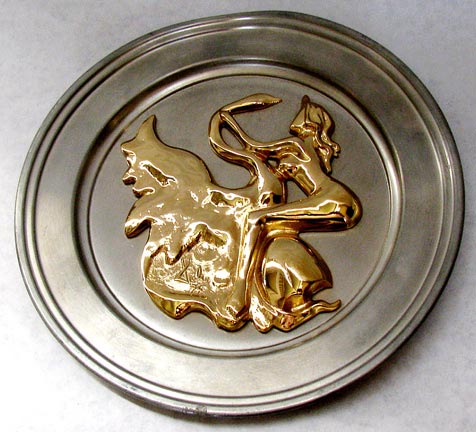
Ms. Friedman was kind enough to offer to me one other item I have not seen before: a Leda and the Swan plate.

This plate is cool.  Unfortunately, I have absolutely no idea about the origin of this item.  I don't think this plate was ever officially released, and there is no proof in cyberspace that this item exists anywhere else on the planet.

Could it be a one-of-a-kind?

Anyway, the emblem appears to be lacquered brass (best guess), and is very bulky.  It weighs about 416g by itself.  The plate is stamped pewter on the back, and weighs about 500g by itself.  I know the individual weights because the emblem loosened in shipping, so I removed it and properly re-attached it with double-sided tape.  The plate is 23cm, or just over 9" in diameter.

The emblem is in perfect condition, but the plate itself is in rough shape.  It has a number of dents, dings, scratches, and scuffs.  Here are several pictures which hide most of those blemishes.


It is very difficult to estimate the value of rare or one-of-a-kind items.  As for the pewter medallion, I think it has relatively little value.  The silver limited edition Leda medallion/pendant, while relatively rare, appears to be worth only about $50.  This pewter version, even if it is a test strike, is probably worth only about $50 at best, simply because demand appears to be low.

I have a different view of the plate.  I think this plate is quite valuable.  If my suspicion that this is a one-of-a-kind is true, I think this is a very important and valuable piece.  As a sample project that never came to fruition, it could easily be worth $200-$300 on the low end, and about $1,500 on the high end.  On the other hand, if it's just a cheap piece of crap, then it's worth about $40. 

Until more information about these pieces turns up, the jury's out.

I will leave you with a dedicatory picture from Dali to the late Mr. Friedman that Ms. Friedman shared with me.  Let this be a lasting tribute to two great men who, more than 35 years later, live on through their inspiration of creative contributions by the living inhabitants of our race on this planet.

Bravo Friedman!  Bravo Dali!


Friday, July 29, 2011

Springbok Puzzle by Salvador Dali: "Double Image/Apparition of Voltaire" (1965).

Springbok Puzzle by Salvador Dali:
"Double Image/Apparition of Voltaire" (1965)

When I first received my Dali Springbok puzzle, I was surprized at how big the box is.  Having only seen pictures on the internet, I realized that the pictures don't give you a feel for the size of this item.
2nd Edition puzzle with box.

The box has a 14.25" dimater and the puzzle has a whopping 20.5" diameter (box incorrectly states 20.25").  The box says that there are over 500 pieces.  I didn't count them, but with a puzzle this size and with this many pieces, you need a large table to do it right.

I am not an experienced puzzler, but the puzzle was not too difficult to assemble.  I estimate that it took me fewer than 10 hours to complete over the course of a week.

If you are looking to add one of these puzzles to your collection, you should know that there are two editions which can be primarily distinguished by the bottom of the box.

1st Edition puzzle box bottom.
2nd Edition puzzle box bottom.
The two editions can also be distinguished by the puzzle pieces which are not identical.  In other words, the puzzle editions are unique, so the pieces are not interchangeable.  You should be able to use the outer pieces of the 2nd Edition puzzle pictured at the top, or the 1st Edition puzzle pictured at the bottom, if you need an identification.

If you really want to get crazy, you can also distinguish the box top of each edition.  The copyright notice is at about the 7 o'clock position on the 1st Edition box whereas the copyright notice is at about the 6 o'clock position on the 2nd Edition box.
1st Edition box top.
2nd Edition box top.
1st Edition puzzle.
Both editions of this puzzle are typically quite rare.  Auction prices tend to run higher for the 1st Edition puzzle, and incomplete puzzles generally go unsold at any price.

A 1st Edition puzzle will likely cost you about $75, and a 2nd Edition puzzle will likely cost you about $45.

Thursday, July 21, 2011

Dali's Teatro Museo Figueras Inauguration Lithograph Poster (1974).

Dali's Teatro Museo Figueras
Inauguration Lithograph Poster (1974).

The search is on!  It appears that there were at least 20 different designs used to produce the lithograph posters for the Teatro Museo Figueras inauguration in September, 1974.  I now have two of them in my collection.

The first features an image from the Twelve Tribes of Israel print suite (Field catalog #72-6, pp. 78-79) titled "Issachar" (Isacar). 

The colors on the large lithographic image are vivid, and frame the piece nicely.  An attractive poster to add to your collection.

Field notes that there were 3000 of these posters produced for the inauguration of the Teatre-Museu Dali de Figueras, making this poster relatively common. 

You can expect to pay about $25 for this poster on the low end.

This next poster features an image from the After 50 Years of Surrealism print suite (Field catalog #74-8, pp. 94-95) titled "Le Grand Inquisiteur chasse le serviteur" (The Grand Inquisitor expels the Savior).

The colors on the large lithographic image are more subdued than the one above, but it is still a captivating image.

Field notes that there were 300 of these posters produced for Teatro-Museu in Figueras, making this poster far more rare than the one above.

You can expect to pay about $45 for this poster.

Friday, July 8, 2011

The Lincoln Mint 1972 Annual Easter Plate: "Easter Christ" by Salvador Dali.

The Lincoln Mint 1972 Annual Easter Plate
"Easter Christ"
by Salvador Dali.

The card that comes with this plate boasts that it is Dali's first work created especially for reproduction in a precious metal plate.

This sterling silver plate measures almost 9" across, reportedly weighs about 325 g, and is numbered on the reverse side with a 4-digit serial number (a larger number of digits has not been observed).  It is reported that this is a limited edition of 20,000.

Of the three Lincoln Mint Dali plates, this one is the most common, yet typically sells for closest to the actual value of the silver (~$348) at today's market price (~$36 / troy ounce).  So, expect to pay just under $350 for this one.

Though this plate is common, there are many for sale at outrageous prices far in excess of the aforementioned estimate.  So, considering the number of plates for sale at a reasonable market price may make this among the less common of the three Lincoln Mint Dali plates.

Also note that this plate has been made in sterling vermeil (sterling silver plated in gold).  These are far less common, but still sell for the same price as the sterling silver version.

Both come in a sturdy white presentation box with a purple silk interior.  The information card accompanying the plate is also pictured here.